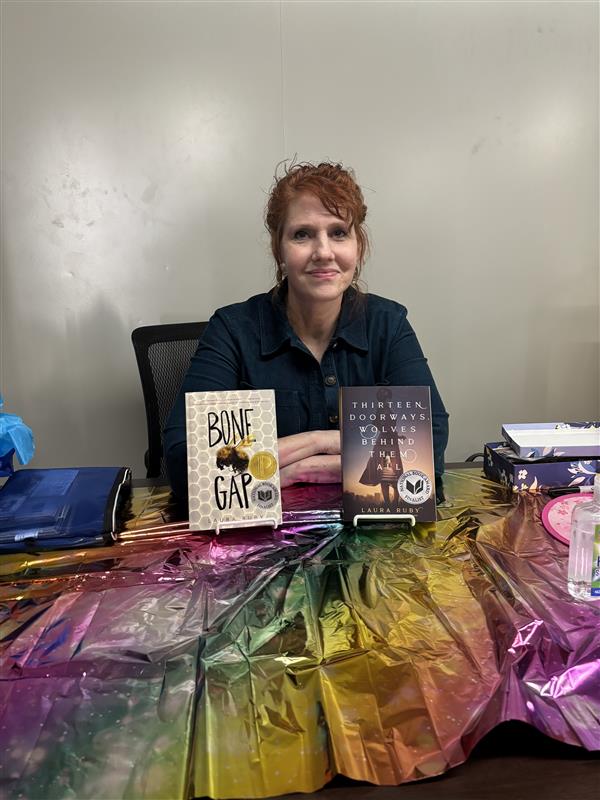
Recently, author Laura Ruby came to Morton East’s knowledge center to speak to students about writing young adult literature, answer questions, and sign copies of her book Bone Gap.
According to Google AI, Laura Ruby is an American novelist recognized for her work in young adult literature. Her novel Bone Gap is critically acclaimed for its blend of magical realism and mystery and received the Michael L. Printz Award.
She answered these questions from students about her books and the writing process:
What gave you the idea to write Bone Gap?
When I was driving through a cornfield, I realized I hadn’t written anything about the Midwest before. As I drove through it, it gave me a strange, spooky feeling in a unique way, and it made me wonder about the mystery behind it. It felt like an interesting setting that made me want to write about it. That’s also how I came up with the character Finn, and how the story started to take shape.
Many of your stories are about teens who feel different or misunderstood. Why?
I think a lot of people feel a little misunderstood. Maybe not everyone—some people just go with the flow—but I’m not one of those people. That’s why I try to give strong emotions to my characters, so readers can connect with them.
Do you think those stories are important for young readers?
Yes, I think those stories are important because they help young readers feel seen and understood, especially if they are going through similar experiences.
When you write teen characters, how do you make them sound like real teenagers?
That’s always a challenge. I try not to use too much slang so the story doesn’t feel tied to a specific time period. I don’t want it to sound outdated unless I’m using it in a fun or intentional way. It’s easier when writing about a specific era because I can repeat the slang from that time. I also try to be authentic in what I write. I have nieces and kids who help me figure out if something sounds off or overdone, which really helps because I can fix it before publishing.
What advice would you give to a high school student who wants to become a writer someday?
It might sound boring, but read as much as you can, and read different genres so you can discover new interests. What you love will always be there. It also helps to write everything down when you’re thinking about it, because that can help you develop more details for your story. Do what you love and publish when you’re ready. Don’t worry about whether it will sell or if you’ll make money right away, because writing is about expressing yourself, not just giving people what they want.
Many students want to know this: Can you tell us if you make money from writing, and how hard it is to earn a living as an author?
It can be very hard to make a living from writing. A lot of my friends and coworkers have two jobs, and writing is more like a side job because the income can be unpredictable. It can go up and down like a roller coaster. You might be able to make a living from it, but then suddenly it decreases and you barely earn anything. So it can be difficult. I can’t give an exact number, but in my case, I feel lucky because my books received good attention, and people really liked them. I was even able to win awards for my work.